Tuesday, January 31, 2017

Interview with Christopher Cvitanovic #oceanoptimism

Dr Chris Cvitanovic is an Interdisciplinary Research Fellow specialized in knowledge exchange, stakeholder engagement and the governance of marine resources, working at the Centre for Marine Socioecology at the University of Tasmania. Contrarily to most researchers we interview, Chris also has experience working for the government, which gives him a unique approach and understanding of science and policy making, which he certainly shares with enthusiasm and a good dose of humor.


FEME: How do you think that social sciences could better interact with environmental sciences?

Chris: I think that both disciplines already have an appreciation of each other, but unfortunately, this doesn’t always translate into more integrative and interdisciplinary research.  I think that researchers need to work towards understanding what each discipline can do by accepting their own limitations, by respecting their differences, and by trying to negotiate the way that the individuals can work together. I think if science is going to be interdisciplinary, the individuals really need to drive it. People need to step out of their comfort zones and collaborate as broadly as possible.  


FEME: We heard that you worked for the government for a while, so, what was your main motivation to quit this job?

Chris: Ah, good question! I joined the government wanting to make a difference for conservation, but over time I became disillusioned with how the government used scientific information and the way that decisions tended to be politically driven, opposed to environmentally driven, or socially driven. I became really interested in how to change that relationship so that we make decisions based on evidence instead on a political will. So I left the government because there weren’t a lot of people doing research in that space and I thought it was a good space for me due to my background. So I left the government to try to improve the way the governments use science in their decision-making processes.

FEME: What was the main lesson you learned when you worked for the government?

Chris: My main lesson was that government employees are people, just like you and I. There is this big cultural gap between scientists and decision makers, and often we think quite negatively about decision makers. My biggest lesson was that decision makers and policy makers are very passionate, they are just like scientists, they want the best outcome. There are things that stop them; political agendas or institutional factors such as bad leadership. However, I think that on roots levels everyone wants the same: a better marine environment. And I think we can harness that passion that everyone has, that passion for conservation. The thing I learned is that we can actually work together as a scientific and a management community to achieve really good things. 

FEME: And how can you apply these lessons in science?

Chris: I like to share what I have learned with people like yourself and students who have not had that sort of exposure to the government. I think a lot of the way we train our students, we don’t expose them to policy or management; they know it is there, but they do not understand it. So, for me, it is what I am trying to give back to the next generation of scientists; to help them understand how they can influence it. I think for me it is about still trying to do research on how we make it better and about pushing the case for trying to do things better and using the energy of the next generation of scientists who are trying to improve things.

FEME: What changes you would like to see in scientific community in the future?

Chris: I would like to see a greater appreciation for everybody, a more inclusive research culture.  I think that there is still a lot of negativity towards certain disciplines or the way certain disciplines operate, there is still a lot of negativity towards the government and the government officials.  We need to embrace our differences, and work together to solve the worlds big problems.


I also think we need to be a lot more positive and I would like to see more ocean optimism, instead of always saying the negative story. As a scientific community there is a lot of good stories to be told. And I think if we tell the good stories, as much as the bad stories, if not more, I think we can actually get a lot more of the public interested, engaged and excited about trying to influence their behaviour. So I think as a scientific community we need to try to engage with the community and, make them feel positive about what they can do to help ocean conservation. #oceanoptimism 

Wednesday, January 18, 2017

Whale hunting in Brazil and what we didn’t learn from it!

To this day, our knowledge on Brazilian whale hunting is still blurred, only few articles and books approach this subject and even those leave tremendous gaps about an activity that is supposed to have killed more than 4 thousand whales per year along the Brazilian coast in its prime years. Although it may sound bizarre for the younger ears, whale hunting only ended in Brazil in 1986. With such a recent past we may wonder if we have learned anything from an activity that almost drove many whale species to extinction that may help us avoid the same mistake with other species. 

Even though there is no definitive evidence, some researchers believe that the first indigenous living in Brazil also hunted coastal whales, prior to the arrival of the Portuguese. However, large-scale whaling only began after 1602, when Portugal issued the first whaling license for Brazil. The first whaling installation was built in the island of Itaparica, Bahia state, followed by several others from the south to the north coast (states of Rio de Janeiro, São Paulo, Santa Catarina and Paraíba). In the next two centuries whales, mainly southern right whale, were exploited without any kind of control. In its first years, 3 to 4 thousand whales, mainly southern right female whales with offspring, are estimated to have been annually killed. The massacre of the adult reproductive females and their calves could not have a different result: in 1786 the annual catches of southern right whales fell to a thousand and kept declining until 1819, when only 59 individuals were hunted. As the catches of southern right whales declined, the target species changed in a desperate attempt to keep the activity profitable.

Whales were hunted mainly for its fat, but practically nothing of the animal would go to waste. The fat was melted to make oil lamps to illuminate houses, streets and sugar cane mills. Part of the oil produced in Brazil was exported. The fins were also exported to Europe and used in various objects, such as umbrellas, brushes, and corsets. The meat was not really appreciated; it was first distributed among the slaves, the free workers and the poor, then later followed by an unsuccessful attempt to popularize its consumption. When that failed, the meat started being exported to Japan.

Whaling was first done on small rowing and sailboats with manual harpoons. It was only in 1911 that a new Norwegian technology, using an explosive harpoon and large steam-powered whalers, arrived in Brazil, boosting the industry and accelerating further the already exhausted resource. To make matters worse, in 1912 the Brazilian government offered significant concessions aimed at revitalizing the whaling industry by attracting foreign capital and technology. At this point, other species were already being exploited as well, mainly the humpback whale and occasionally minke, and sperm whale.

Imbituba-SC, anos 50 – Foto de João Hipólito do Nascimento (1920-1992).
There was no regulation for whaling in Brazil, until in 1923 a general decree forbade the catching of calves and females with offspring. In 1967 Brazil finally joined international agreements banning the hunting of blue whales, but it took the country another 19 years of much fight and pressure from environmental groups and the media to finally ban whaling in 1986.
 
By the time of the ban, most of the whales used for oil were commercially extinct, but by then the focus had already changed. In the 1950’s Brazil aligned its interests in modernizing its fishing with the Japanese’s interest in whaling for meat and also in fishing the Brazilian waters. For Japan, even the small whales that visited the coast of Brazil were worth the effort, and they did hunt the Brazilian coast legally until 1986. Therefore, the Brazilian whaling history compromised large and small species alike, including whales that were good for their oil or not. It is estimate that eight species have been seriously affected, and only a few so far have given signs of recovery.   

Exploiting a resource to near extinction without any regulation, with subsidies to modernize and increase the catch capacity of the fleet seems like a perfect recipe for an ecosystem doom. Under such catastrophic events, we would expect people to learn, but instead we chose to follow the footsteps of our not so old whalers. Our targets have changed, we like the big fish now, but as they also go, we move on to the smaller ones as well. And we are cooking our recipe for the fish doom in a not so low a fire after all...

Bibliography

A história da Caça de Baleias no Brasil: De peixe real a iguaria japonesa. William Edmundson e Ian Hart. Disal Editora. 311 p. 2014.
A history of Whaling in Brazil: from royal fish to Japanese delicaly
. William Edmundson and Ian Hart. Ed. Pub. Pequena. 234 p. 2017.

By Ludmila Damasio


Friday, December 2, 2016

Interviewing Dr. Beth Fulton

It is always a pleasure to talk to people who think out of the box and Beth is indeed one of those! These days, thinking out of the box may just well mean to do things in the ways we did before, seeing the whole picture and not only the parts. Beth talks about this and much more here, but before we get there, let’s just remind you about who Beth Fulton is, a name very familiar for those studying fisheries. Beth has a PhD in ecomathematics from the University of Tasmania and is a leading marine ecosystem modeller with a background in marine ecology, mathematics and scientific programming. She has been leading the CSIRO ecosystem modelling efforts in Australia for the past 15 years. Her science focus is on marine natural resource management, conservation and ecosystems. 


Beth’s team focuses on the development of programs that model marine ecosystem models (e.g. Atlantis, InVitro and CORSA). In particular, such modelling software give equal attention to biophysical and human components of marine ecosystems. These models allow users to explore the impacts and management of the myriad pressures on marine and coastal environments. The approach underpins CSIRO’s research into managing potentially competing uses of Australia’s marine environments and adaptation to global change and is currently used up by researchers and management bodies in 26 countries around the world. 

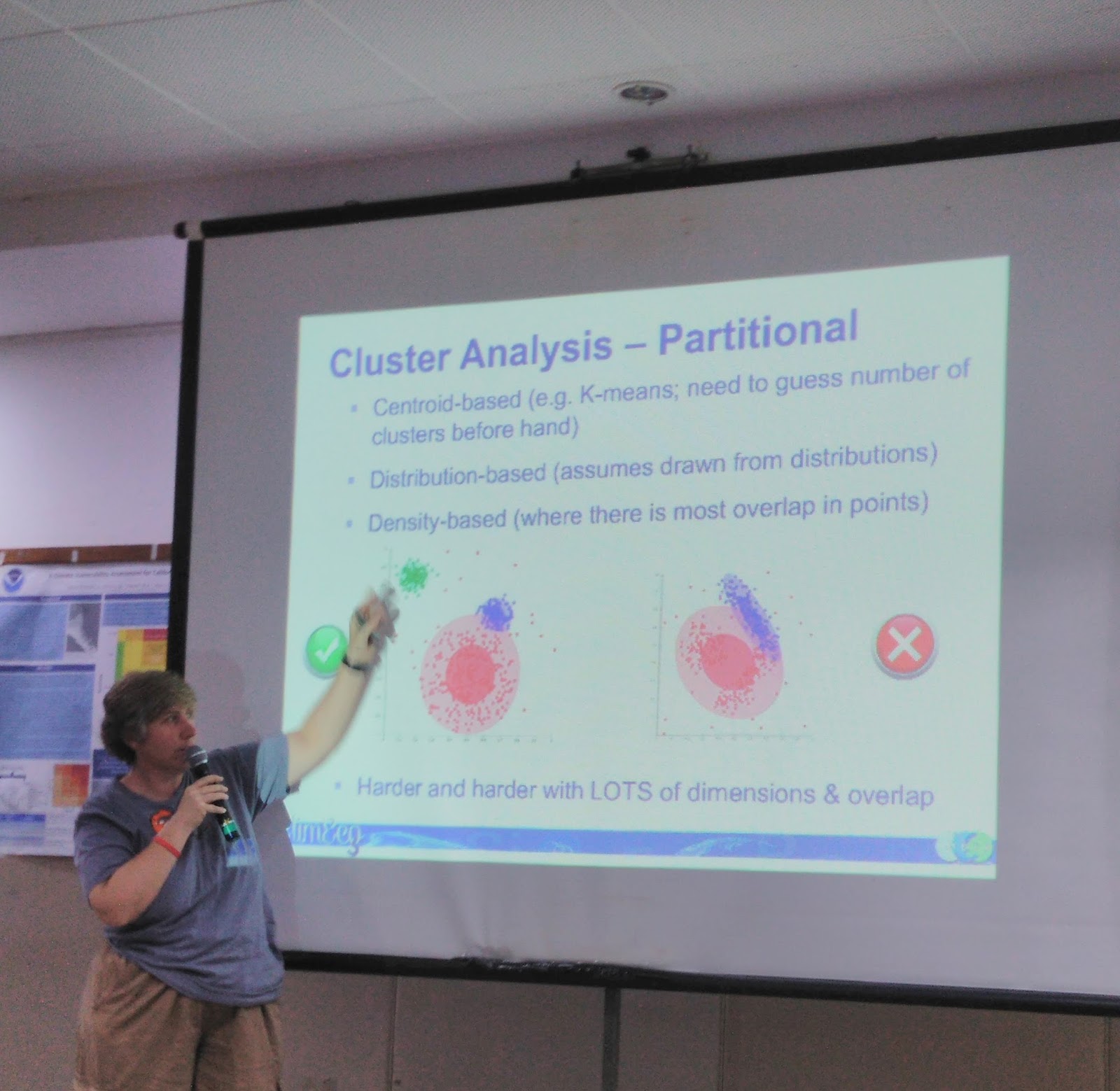
In August (2016) during the IMBER ClimEco5 Summer School in Natal, Brazil, we had a chance to have a quick chat with her. Check it out!


FEME: There is still some resistance from scientists in relation to the modeling of nature. For instance, some of them believe that is impossible to model nature with all its complexity. What is your view on that?

Beth Fulton: I would say that everybody models nature already, they just do it in their heads. And so, by getting the models out into mathematics or onto a piece of paper you at least have all of the assumptions clear, so that everybody can talk around it. You are not assuming that people know the same things that you do, because people will make decisions regardless of the models or not. So, it is better to have that information out there to make clear what we do and what we don’t know and to help understanding than to just give up and keep it all in their heads and keep it messy. 

FEME: In your opinion, how reliable are IPCC scenarios?

Beth Fulton: Of course there is going to be things that don’t work exactly like in the model. It is just a model! But the basic fundamental principles of the way that the atmosphere works and what that means for the oceans have been known for over a hundred years. They got the same basic answers with pencils and papers a hundred years ago. The finer details of today around specific locations are why we continue to need to refine this work. But they (IPCC scenarios) are basically reliable for the general pattern of change. We can’t wait to the changes to happen to see what it is before we can react, because of the long- term timeframes. The changes we are making today will already influence the next a thousand to a million years of the ocean and the world, so we need to act now. It is like when you save in a bank account, the earlier you save the more difference that you make. That is why you need to just say we don’t know everything perfectly, we might need to change a few things as we go along, but the basic reliability is pretty strong for general patterns.    

FEME: What changes would you like to see in the scientific community for the future?

Beth Fulton: That one I would like to see across all academia: an embracing of the idea that we are all equal, that no group is better than any other group, and that we share that information and understanding together. As we have understood more and more, we have become very constraint into a one little bit of science, which can be so different from place to place. There are thousands of different kinds of science. So, I would like the renaissance idea of all science together across the disciplines. So people have that big broad view again, instead of getting stuck there in their one little bit.


Monday, November 21, 2016

Protecting the reef fish we catch: the case of parrotfish

We already know that parrotfish (Labridae: Scarini) are large (and beautiful!) fishes that play critical functional roles in reef environments when they feed, which in their case, we call “grazing”. Parrotfishes spend their day biting off bits and chunks of algae and other benthic organisms with their beak-like teeth. However, macroalgae may not be their preferred dish, they seem to like smaller diet items then what has been previously assumed. Because of this new finding, they have been recently reclassified as microphagous (“eaters of tiny particles”) (Clements et al., 2016), which by no means diminishes their importance in shaping the reef community. In other words, their nutrition comes from protein-rich autotrophic microorganisms, which in their turn are associated with macro organisms. By eating microorganisms, parrotfish affects the structure and composition of benthic communities by maintaining algae free corals. 
Unfortunately, fishing pressure on parrotfishes has grown in the last decades around the world, and in Brazil, it is not different. Small-scale fisheries are exploiting large numbers of parrotfishes from Brazilian reefs, which could be leading to significant changes in the community structure. In particular, three species, Scarus trispinosus (Valenciennes, 1840), Sparisoma frondosum (Agassiz, 1831) and Sparisoma axillare (Steindachner, 1878), labeled as threatened in 2014, have been intensively targeted, mostly on the northeastern coast.

Scarus trispinosus landings. Photo by Natalia Roos.
In the Brazilian northeast, fishermen use different gears, including gillnets, handlines and spearguns, depending on the parrotfish species targeted. The effects that gears have in a given fishing are important to be understood because they may change catch composition, catch per unit effort (CPUE) and fish size frequencies. Therefore, the understanding of the effects of gear may guide suitable management strategies to maintain fish populations and long-term fishing yields.
The paper “Multiple management strategies to control selectivity on parrotfishes harvesting” assesses gear size selectivity and fishing pressure on the three most caught species of parrotfishes in the Brazilian northeast. The results showed that the annual total catch of S. trispinosus was estimated in 9.4 tons, while S. frondosum and S. axillare (usually caught together) were estimated at 15.4 tons, totaling 24.8 tons of parrotfish fished per year in a tiny area of the Brazilian coast.
Both S. frondosum and S. axillare are being caught by gillnets and handline above the size of first maturity, however, the CPUE value for gillnets are much higher than handline. For S. trispinosus, which is caught with gillnets and spearguns, the scenario is worse. About 80% of all S. trispinosus caught were below the size of first maturity, and most of the immature individuals are coming from gillnet fishery. 


Besides parrotfish artisanal fishing being multi-gear, multi-species and multi-strategy, there are many other problems involving this kind of fishery. First, parrotfishes are also targeted by unreported recreational fishing. Second, Sparisoma species are targeted by trap industrial fishing and exported to other countries. Third, some spearfishermen also hunt at night, when parrotfishes are asleep and much more vulnerable. Fourth, parrotfishes are protogynous hermaphrodite (i.e., they begin their life cycle as a female than they shift to male), and not protecting the larger individuals (males) can lead to several consequences to their reproduction. 
Due to all of these reasons, a multiple strategy approach is suggested for parrotfish management. Besides controlling artisanal gears by establishing a slot size limit for handline and speargun (gears that fishermen can choose the size of fish) and increasing the gillnet mesh size, banning recreational fishing, night fishing and exportation of parrotfishes should be taken into account. It is also important to consider spatial planning to protect sensitive areas. Clearly, all of these measures have to be monitored to ensure good results.    
The implementation of these multiple management strategies may oppose the latest Brazilian Red List, which recommended banning S. trispinosus fishery, as this was classified as Endangered, although it could support the need to manage S. axillare and S. frondosum. These two species are classified as Vulnerable and could be fished under restrictions. A repeal of the list would be a serious hindrance for the conservation and management of parrotfish. On the other hand, if this list is implemented, all the vulnerable species will require specific management measures, and this study is a timely contribution for the ecologically relevant and iconic groups of parrotfishes.

by Natalia Roos


References

Clements, K. D., German, D. P., Piché, J., Tribollet, A., & Choat, J. H. (2016). Integrating ecological roles and trophic diversification on coral reefs: multiple lines of evidence identify parrotfishes as microphages. Biological Journal of the Linnean Society.
Roos, NC, Pennino, MG, Lopes, PF, & Carvalho, AR. 2016. Multiple management strategies to control selectivity on parrotfishes harvesting. Ocean & Coastal Management, 134, 20-29.


Wednesday, November 2, 2016

What do fishermen know about dolphins and why do they know what they know?


Every time you go to a different beach, the most prudent thing to do is asking local people where the safe places to swim are (places with no currents, for example). It is very likely that you would ask people somehow involved with the sea at that particular beach, such as lifeguards, surfers, and fishermen. The reason is obvious: since they are used to the local environment, they would know the risks. The same is true when researching any specific characteristic of a given area. Sometimes, when you want to understand specificities of a place, the best option is to ask local people about its characteristics and dynamics. When living in a place and depending directly on its resources, people learn how to deal with things available at the place. As these people spend time on their daily activities, they also have more opportunities to observe and accumulate knowledge of the surrounding area. Gathering this local ecological knowledge (LEK) is a good way to learn about local features without spending too much time and money, since they would already be the result of local experience through years (and, sometimes, over generations).


Based on this, several researchers have been including the LEK into their studies to learn about the ecology and biology of different species. In our paper [“The behavior of the estuarine dolphin (Sotalia guianensis, van Bénéden, 1864) according to fishermen from different fishing environments”], we investigated the knowledge fishermen had about the behavior of a local dolphin. Even though dolphins are charismatic species, even for researchers, we still have a lot to learn about them because it is not that easy or cheap to study the behavior of species that spend most of their time underwater. Fishermen, on the other hand, have a natural chance to learn about dolphins, simply by performing their profession. But fishermen are just regular human beings and, as such, will have their cultural biases as well that will shape the knowledge they carry.


Sotalia guianensis, PHOTO: http://uk.whales.org
Assuming that such biases would affect knowledge construction, we investigated how the perception of small-scale fishermen regarding the behavior of the estuarine dolphin (Sotalia guianensis) is affected by their education, experience, the type of environment where they predominantly fish, and the extent to which they are involved in dolphin watching tourism. We interviewed fishermen in routine contact with populations of S. guianensis in NE Brazil. Overall, most fishermen correctly reported the habitat, distribution, seasonality, and feeding behavior of this dolphin, besides bringing new insights into the dolphin’s reproductive behavior and its possible migration patterns. As expected, more experienced fishermen provided more details. Interestingly though, those fishermen that studied more years could also provide better details, perhaps suggesting that formal education could fine-tune their perception. Another important finding of this study is that fishermen’s knowledge is widely affected by the fishing environment they commonly use, because dolphins perform different behaviors depending on where they are. This finding has as additional implication and could be used as an attention flag to studies using LEK: you better carefully select your informants depending on what you want to learn, besides considering the effects of their cultural biases. Once you are aware of those limitation, inherent to human beings, be sure that fishermen, besides knowing a lot about fish, may also provide information on cetaceans that could be used in management and conservation when scientific sources are missing or insufficient. 


Manzan, M & LOPES, PFM. 2014. Fishers' knowledge as a source of information about the estuarine dolphin (Sotalia guianensis, van Bénéden, 1864). Environmental Monitoring and Assessment, 187: 4096.


Friday, October 21, 2016

Interview with Laurent Bopp, international expert on climate change

Laurent Bopp is a researcher at the Laboratoire des Sciences du Climat et de l'Environnement (LSCE), Institut Pierre-Simon Laplace (IPSL) in France. His main research interests concern the links between marine biogeochemical cycles, marine ecosystems and climate. He is an expert in marine biogeochemical and ecosystem models (such as the PISCES model), coupled to Earth System Models (such as the IPSL climate model). 


Laurent Bopp during a lecture in the IMBER summer school 2016.

Question: Some researchers say that climate change has a higher impact on women than men. Do you agree? Why? 
Laurent:  It is a good question. I guess it depends a lot on where in the world they are. I mean, society inequalities between men and women are stronger in some places, and surely climate change is believed to increase inequalities. So, that will be the case where such inequalities exist already. Where inequalities are not so pronounced, we hope not to see so many differences in the impacts. 

Question: Which challenge is the hardest to overcome: adapting to climate change or reaching zero emission?
Laurent: I guess we have to do both: go to zero emission and adapt to climate change. And again it will depend where on the planet we are talking about, countries that are very dependent on fossil fuel will have much more difficulties to reduce the emissions, whereas it is believed that countries that have a higher G.D.P will adapt more easily than others. My personal guess is that going to zero emission is difficult, because this is a global goal: if you do it, and your neighbor does not, you simply do not achieve it. Adaptation is much more likely, you can adapt just counting on yourself. So, in a very integrated world, where we share things, maybe we can do both at the same time. In a more fragmented world, adaptation is ok but going to zero emission is impossible. 

Question: What changes would you like to see in the scientific community in the future?

Laurent: I see some nice changes already. But I’d like to see more. So, if I take the examples of the system in France, and I know that in many other places it is the same, it is very hierarchical. We have the professors, then we have the post-docs and the PhD students, and we always see the same ones giving the big presentations, and we should include more flexibility into this. We should have a bit more talking at all levels, not just at the highest ones. But, I’ve seen some changes. So I think it is coming. 


by Natalia Roos

Thursday, October 6, 2016

How new tech is catching IUU fishing in small-boat fisheries

This week Melissa Garren, chief scientific officer of the Pelagic Data Systems and Anne Hawkins of the Kelley Drye & Warren LLP, talk about a new technology against illegal, unregulated, and unreported (IUU) fishing.

Earlier this month, U.S. Secretary of State John Kerry and actor Leonardo Di Caprio unveiled Global Fishing Watch at the Our Ocean Conference in Washington, D.C. As its big-name spokesmen would suggest, Global Fishing Watch is a big deal. Created by Google, Oceana, and SkyTruth, it uses satellite data to track and make public the fishing activity of the world’s largest fishing vessels. This enables public oversight and pressures vessel operators to fish legally.

Global Fishing Watch is a huge step in the fight against illegal, unregulated, and unreported (IUU) fishing, and there also remains much work to be done. Right now, it’s still possible for vessel operators to turn off their satellite tracking devices, and there are many smaller vessels that have no tracking capability at all due to the expense and power requirements of most systems. This poses a significant challenge because ~95 percent of the world’s fishing fleet is comprised of these small vessels.

At Pelagic Data Systems, we developed an autonomous, tamper-proof Vessel Tracking System (VTS) with these small vessels in mind. Our VTS is a solar-powered device, roughly the size and shape of a smartphone, that collects, encrypts, and securely transmits data on a boat’s location, and it can monitor storage temperature and catch methods. By filling in the data gap for small-scale fisheries, this technology complements efforts already under way to rid the world of IUU fishing.


Pelagic Data Systems recently teamed up with Global Fishing Watch and industry partner PT Bali Seafood International (BSI) to begin putting that data on the public map of global fishing. The project is collecting data on small fishing vessels in Indonesia that feed into BSI’s international supply chain, and this data will be made public online through Global Fishing Watch. Projects like this one are wins for traceability, sustainability, and for the fishing industry’s bottom line. Consumers are increasingly demanding seafood caught transparently and through a sustainable supply chain, and companies like BSI are paving the way.

Our vessel tracking systems also provide valuable information for use in marine spatial planning. As Anne Hawkins and I presented at the ICES (International Council for the Exploration of the Sea) Annual Science Conference last week, this data collected by the fishing industry can help to preserve their access to valuable fishing grounds and inform decisions on how new projects in the marine environment are sited. By providing fishing communities with the data-oriented tools to get involved in this process, we empower them to help manage the resources that support their livelihoods.

Ultimately, the more ways we can monitor the world’s fishing fleet, the faster we can eradicate IUU fishing and guarantee that fishing resources relied on by billions of people around the globe are sustainably managed.

by Melissa Garren and Anne Hawkins 


Melissa is a marine biologist who specializes in the intersection of technology and marine conservation. At Pelagic Data Systems, she is responsible for providing scientific leadership and aligning the company's technology development programs with the needs of both the ecosystems and the communities dependent on them.  She holds a B.S. from Yale University, and M.S. and Ph.D. from Scripps Institution of Oceanography, and completed postdoctoral work at MIT in the application of cutting-edge technologies to marine conservation solutions.